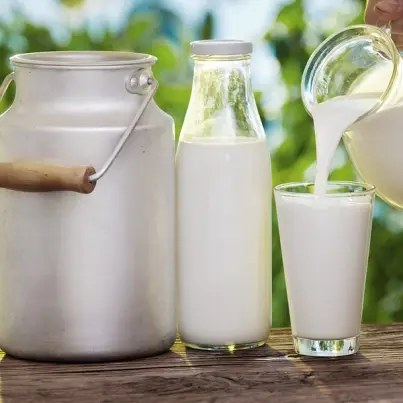
Milk - Is it really that bad?
One of the biggest challenges I face as a trainer is when I ask clients to cut dairy from their diets. I get asked things like 'how can it be that bad for you if EVERYONE drinks it?' or 'if it was that bad why are we not being told and why is it still on sale?', 'how will I get my calcium?', 'my doctor's told me I have to drink it as I have osteoporosis in the family'. I didn't want this article to be just another rant about why you shouldn't be drinking milk (although there may be a bit of that) but more one that will answer some of the FAQs that I get with regards to dairy, and also to reassure myself that I have made the right choice to stay off it. I more than anyone used to love drinking milk, eating cheese, yoghurt, in fact pretty much all dairy, especially a certain brand of ice-cream in tubs at a time!
But what will I have on my cereal?
What do I put in my tea?
Does it also include butter, cheese and yoghurt etc.?
If you are asking yourself these questions then read on, you can make your own choices at the end.
It is difficult to know who to believe; just typing a search of milk alone into a search engine will bring up literally millions of results. I have looked through tons of these and what does become clear is that the articles viewing milk in a negative light all have significant research to back up their findings, whereas others promoting it as a 'health' food base findings on theory rather than fact simply listing the properties of milk such as calcium, vitamin D etc. and then issuing information as to the benefits of calcium and vitamin D on the human body, not the specific benefits of milk.
I always get asked how I know I can believe the people I get my information from. Well, in my eyes the guys I believe are trusted sources, either trainers or nutritionists etc. but I know that's still not going to wash with you as you don't know them and hold the same trust that I do. It is for that reason I have conducted my own research to offer you my opinion.
The benefits of milk? - One source designed to provide nutritional info for kid's states "milk is rich in protein and calcium which help build the muscles you need to throw a ball or climb a tree", while another states "for those who can digest cow's milk, a little bit of non-fat or low-fat milk in the diet is probably fine and contains a dose of nutrition". Pretty inconclusive don't you think? Of course, not all research is like this, I have picked some extreme examples. Why though were we told all those years ago to drink a pint of milk a day? While it's true that opinions constantly change, particularly so in the field of nutrition we must not lose sight of the fact that the milk business is BIG business. In the UK we manage to get through somewhere in the region of 5 billion litres of the stuff each year, and that's before we even consider the additional amount we put into dairy products like cheeses and yoghurts. The dairy industry spend millions in order to promote their products as being healthy in order to boost their profits just as any big business would do. This doesn't necessarily mean that it's true; don't forget it's not that long ago since Kitkat used to promote their chocolate biscuit as an ideal lunch replacement! So why don't the government put a stop to it? The fact that dairy producers are subsidised and would require further subsidies if sales dropped means they are hardly likely to. You could ask yourself the same question about cigarettes, if they are really that bad then why haven't they been banned? Where would the tax money come from if this happened?
But I need milk for strong bones....Having studied at university the incidence and effects of falls in the elderly and the prevalence of osteoporosis I know that this is a big concern for many people, and it should be. It is a problem that has appeared in my family's history and therefore one of the factors that sparked me to further research and ultimately led me to dairy. All we seem to hear is calcium, calcium, calcium, but interestingly the calcium in milk is actually made very difficult to digest due to the high protein content, of which this is thought to be one of the contributing factors of osteoporosis! If we look at it from a natural point of view again, animals in the wild such as elephants, rhinos, lions etc. all seem perfectly capable of building strong bones without having to drink cow's milk! Looking at it geographically we also see that invariably countries with the highest incidences of osteoporosis are also countries where the population have a high intake of dairy products.
Heather Mills famous and somewhat bizarre rant claiming we should drink rats milk and dogs milk to save the planet from deforestation for livestock seemed like rather an odd outburst at the time, but whether you agree or disagree is it really any more unusual for human beings to drink rats or dogs milk? It is after all just another animal, like a cow! The point is however that the milk of every species is uniquely tailored to the specific requirements of that animal. Cow's milk therefore by default is not created with humans in mind. It is designed to provide the key nutrients to baby calves. Also, it is as unnatural to be drinking the milk of another species as it would be to continue to drink your mother's milk into adulthood. We may all laugh at the Little Britain scenario, but this is in essence what many of us are doing daily! In a natural environment, it would be impossible for an animal to continue with the drinking of milk after weaning.
The rant part...With every glass of milk we drink we also choose to ingest antibiotics, pesticides, chemicals, hormones, blood and even pus, yep you read right. But surely there are guidelines in place and limits so that this doesn't reach us in the cartons in our fridges? Well yes there are, it is legal for milk containing up to 400 million pus cells per litre to be sold to us for human consumption, so thank goodness for those guidelines! We must not lose sight of the fact either that milk contains large quantities of casein, far more than in human milk which is very difficult to digest. So when you see slapped across the side of a protein tub 'contains slow releasing casein protein' that's because it is like liquid glue to the body and hard to process, and indeed it actually is used as a glue more commonly to bind wooden furniture together - just perfect for slow release then when building muscle or trying to lose weight!
Many studies have, with overwhelming evidence linked the consumption of dairy products with the incidence of a wide range of diseases and illnesses including heart disease, diabetes, obesity, cancer and osteoporosis. I could go on, but for those of you that have stuck this out this far I don't think I need to.
Of course you don't have to listen to any of this, and you might not as I myself didn't take it all on board straight away just from listening to one person, but I did think there might be some truth in it, so I looked further. Do the same, do some research and see what you find, I urge you to do this and stop drinking it today for your own health. Others might just dismiss this as absolute crap! I don't mind, it's your choice at the end of the day, but if this article changes the life of even just one person then it has been worthwhile.
Phil Robertson